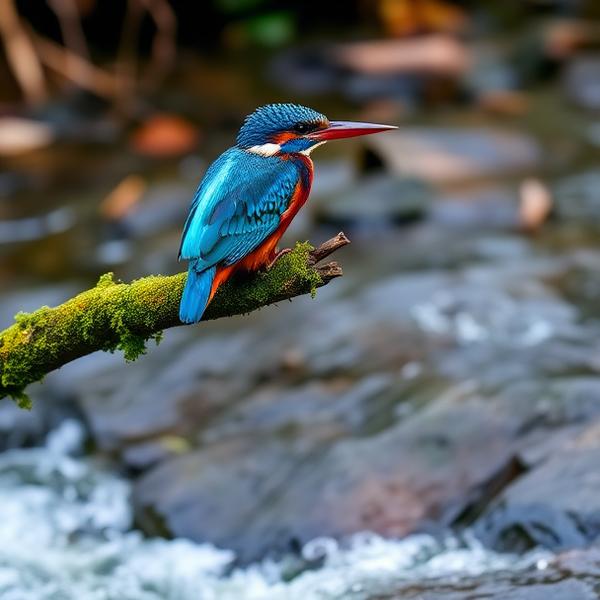
Common Kingfisher

Common Kingfisher

Alcedo atthis · "The Sapphire Arrow"

Population decreasing

My superpower

I dive at 40 km/h and correct for underwater refraction mid-flight.

Did you know

My blue feathers aren't actually blue — they're transparent, scattering light like a prism.

Why I matter

WQ

Water Quality Indicator

You'll only find me on clean, healthy rivers — my presence means the water is thriving.

Species information

About the Common Kingfisher

The Common Kingfisher (Alcedo atthis) is one of Europe's most electric-looking birds — cobalt-blue back, orange belly, dagger-sharp bill, no bigger than a sparrow. Most people who spot one see a low, straight blue flash over a river and then nothing.

Kingfishers are found across Europe, Asia and North Africa. They are a strong indicator of freshwater health: they can only survive on rivers, canals and lakes clean enough to hold small fish and clear enough to see them.

Habitat & range

Kingfishers need slow-flowing or still, unpolluted water with clear visibility and low, overhanging perches to hunt from. They dig their nest tunnels — up to a metre long — into vertical earth banks along riverbanks and disused quarries.

Severe winters that freeze rivers, and summer floods that collapse nest tunnels, are the two biggest natural threats.

Diet

The Kingfisher's diet is around 60% small fish (minnows, sticklebacks, bullheads, small trout), with aquatic insects and freshwater shrimp making up the rest. A pair with a full brood needs to catch around 100 fish a day.

Kingfishers hunt by watching from a low perch, then diving head-first with wings folded, closing a transparent third eyelid the moment they hit the water.

Behaviour & life cycle

Kingfishers are strongly territorial and mostly solitary outside the breeding season. Territories are stretched along a linear kilometre or two of river.

In spring, the male courtship-feeds the female with a fish held head-first. Pairs raise 2–3 broods a year in a chamber at the end of the earth tunnel; the chicks are fed a constant supply of small fish and leave the nest in about 25 days.

Main threats

River pollution — especially agricultural run-off and sewage discharges — reduces fish stocks and clouds the water so Kingfishers can no longer see prey. Bank engineering, canalisation and the loss of natural earth banks destroys nesting sites. Cold winters that freeze fresh water for weeks can crash local populations.

Taxonomy

Kingdom
Animalia
Phylum
Chordata
Class
Aves
Order
Coraciiformes
Family
Alcedinidae
Species
Alcedo atthis

Help me

2 active ways
Support your local river trust
Never dump anything down storm drains

Take real action

6 verified

Every link goes to the official conservation organisation. Wildly takes no fee.

Local & national

adopt · RSPB

Adopt a Kingfisher

Can't take part? Help it reach someone who can.

donate · The Rivers Trust

Fund clean rivers

Can't take part? Help it reach someone who can.

volunteer · WWT

Volunteer at a wetland reserve

Can't take part? Help it reach someone who can.

Global & international

learn · BirdLife International

Global Kingfisher factsheet

Can't take part? Help it reach someone who can.

learn · IUCN Red List

Official Red List assessment

Can't take part? Help it reach someone who can.

donate · WWF International

Support freshwater conservation

Can't take part? Help it reach someone who can.
Learn & earn

Sign in to take the species quiz and keep your learning history.

Conservation

Loading…

Status

Trend

Assessed

Range

Source: iNaturalist

Frequently asked questions

Are Kingfishers rare?

+

Globally the Common Kingfisher is listed as Least Concern, but in the UK it is amber-listed and in serious decline in England, largely because of river pollution and severe winters.

Why are Kingfishers so blue?

+

Kingfisher feathers aren't actually pigmented blue. The colour comes from microscopic structures in the feather that scatter light — a phenomenon called structural colouration. That's why they seem to glow.

Where is the best place to see a Kingfisher?

+

Slow, clean rivers and canals with overhanging branches are ideal — early morning, from a bridge or a fishing platform, sitting still. In the UK, the Norfolk Broads, the River Severn, Yorkshire's Wharfe and London's Regent's Canal are all reliable.

What do Kingfishers eat?

+

Small freshwater fish — minnows, sticklebacks, bullheads and small trout — plus aquatic insects and freshwater shrimp. A breeding pair catches around 100 fish a day when feeding chicks.

Wildly community findings
Community

Recent sightings

+ Add yours