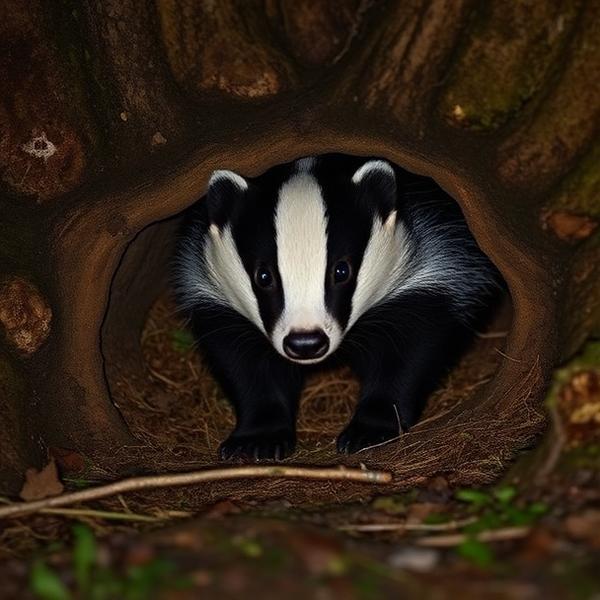
About the European Badger
The European Badger (Meles meles) is a stocky, black-and-white striped mammal that lives in some of the oldest continuously occupied dwellings in Europe — huge underground setts that can house generations of the same family for over a century.
Badgers are found from Ireland to the Volga and from Scandinavia to southern Italy. They are one of the largest carnivores still widely present in western Europe.
Habitat & range
Badgers dig their setts into well-drained slopes in mixed woodland, hedgerow banks and pastureland with plenty of earthworms. A large sett can contain hundreds of metres of tunnels, dozens of chambers, and multiple entrances.
Territories are marked with communal latrines at boundaries and defended vigorously against neighbouring clans.
Diet
Badgers are omnivores, but their diet is dominated by earthworms — up to 200 a night when conditions are damp. They also eat beetles, small mammals, fallen fruit, cereals, wasp grubs and, occasionally, hedgehogs.
Behaviour & life cycle
Badgers live in social groups called clans, typically 4–8 animals sharing a sett. They are strictly nocturnal, emerging just after dark to forage in a network of well-worn paths across the territory.
Cubs are born in early spring in a deep chamber lined with dry grass and bracken carried backwards down the tunnel. They emerge above ground at about eight weeks old.
Main threats
European Badgers are listed as Least Concern globally, but face significant threats in some countries: road traffic kills around 50,000 badgers a year in the UK alone, and government-sanctioned culling in response to bovine tuberculosis has removed over 200,000 badgers from the English countryside since 2013 — a policy widely disputed by scientists.
Taxonomy
- Kingdom
- Animalia
- Phylum
- Chordata
- Class
- Mammalia
- Order
- Carnivora
- Family
- Mustelidae
- Species
- Meles meles